


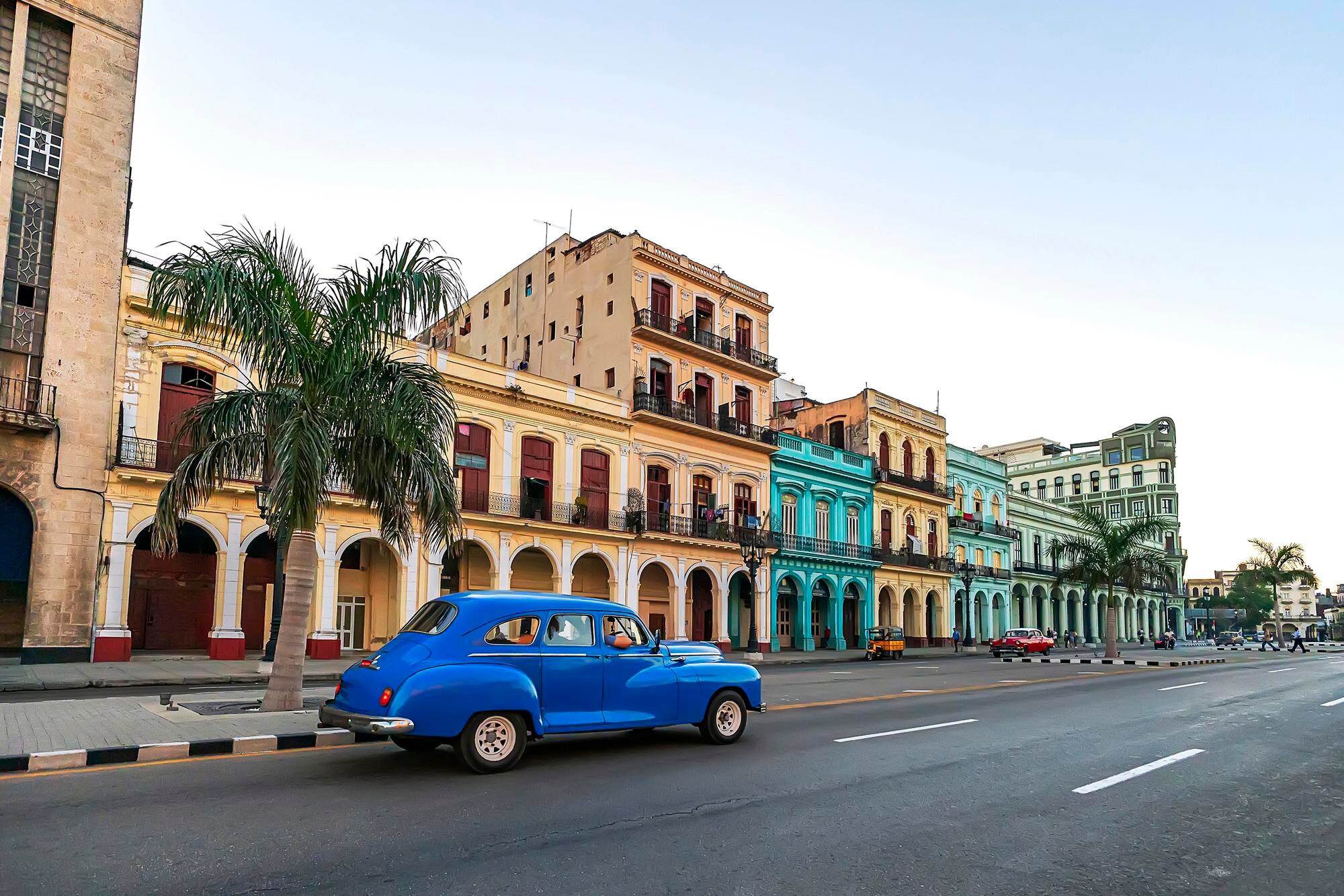
Across Cuba, classic cars still take passengers on everyday journeys. The archipelago’s music draws on Spanish and African traditions. Its history includes colonial sugar plantations and a revolution that reshaped education.
A mechanic’s engine swap or a young teacher’s lantern can bring that history into focus. These Cuba facts link familiar sights to the people and histories behind them.
In This Article
- 1. Cuba Is an Archipelago
- 2. Classic Cars Reflect Transport History
- 3. The Bee Hummingbird Is the World’s Smallest Bird
- 4. Spanish Has a Distinct Cuban Character
- 5. Santería Has Yoruba Roots
- 6. Music and Dance Connect Different Traditions
- 7. Baseball Has Deep Cuban Roots
- 8. Dominoes Are a Social Game
- 9. Cuba’s Railway Began in 1837
- 10. Ernest Hemingway Made a Home Near Havana
- 11. UNESCO Recognizes Different Kinds of Heritage
- 12. Literacy Has a Revolutionary History
- Key Takeaways
- Frequently Asked Questions
- Look Beyond Cuba’s Familiar Images
1. Cuba Is an Archipelago
The Caribbean’s largest island stretches roughly 750 miles from east to west. Havana sits in the west, with Santiago de Cuba near the eastern end. Traveling between these cities means crossing much of the main island, not simply moving between neighboring cities.
The country extends beyond that main island to Isla de la Juventud, smaller islands, and cays. To show all of Cuba, a map must cover the whole archipelago rather than its largest island alone.
2. Classic Cars Reflect Transport History
Truck diesel engines have replaced the original engines in some pre-1959 cars. An American body does not necessarily mean an American engine sits beneath it. To keep these aging vehicles running, mechanics also make replacement parts themselves.
These engine swaps and homemade parts reflect the limited replacement options under the U.S. embargo and Cuban import restrictions. Necessity may have transformed nearly all of a car’s workings, whatever its polished hood suggests. The roads also carry Soviet-era models and newer imports alongside the old American cars.
3. The Bee Hummingbird Is the World’s Smallest Bird
At about 2 inches long, a bee hummingbird is roughly the length of an adult’s thumb. Even at that tiny size, males are smaller than females.
Nectar and small arthropods make up the diet of this bird native to Cuba. Its trips from flower to flower also carry pollen.
4. Spanish Has a Distinct Cuban Character
In Cuban Spanish, a syllable-ending “s” may soften or disappear altogether. The greeting “¿Cómo estás?” might therefore sound like “¿Cómo etá?” Pronunciation varies, though, so take this as an example rather than a transcript of every conversation in Havana.
Vocabulary tells another part of the story: Spanish is the official language, yet its words carry traces of older histories. “Bohío,” meaning a traditional dwelling, comes from Taíno and keeps an Indigenous legacy present in everyday Spanish.
5. Santería Has Yoruba Roots
During Santería ceremonies, batá drums may accompany songs dedicated to orishas. These rhythms are part of religious worship, not merely entertainment.
Santería, also known as Regla de Ocha, grew from enslaved Africans’ religious traditions, particularly those of Yoruba people. Its practitioners honor orishas linked to nature and human life. That history also includes connections with Catholic saints. The songs and ceremonies remain expressions of a living religious practice.
6. Music and Dance Connect Different Traditions
The bright, ringing sound of the tres comes from strings grouped in three pairs and gives son cubano a distinctive tone. Short phrases weave around the singing, letting the instrument carry a voice of its own.
The roots of son lie in eastern Cuba, where Spanish-derived song forms met African-derived rhythms. Son later helped shape salsa, but it represents just one part of Cuban music. Danzón, rumba, and casino have their own separate histories.
7. Baseball Has Deep Cuban Roots
Habana beat Matanzas 51–9 in an organized game held in Matanzas in 1874. That lopsided score records baseball’s place in Cuba’s history long before the revolution.
Regional loyalties remain a strong part of that baseball tradition, especially in the rivalry between Havana’s Industriales and Santiago de Cuba. Provincial fans have a side to cheer for and a rival to cheer against. Baseball can thus put the capital and the province on opposing sides.
8. Dominoes Are a Social Game
The sharp clack of a winning tile on a folding table draws a reaction from the other players. What looked like a quiet game a moment ago suddenly sounds anything but quiet.
The challenge behind those reactions lies in reading the clues each play leaves on the table. Cuban dominoes usually uses a double-nine set of 55 tiles. Four players often pair up into two partnerships, but you cannot see your partner’s hand. Instead, you have to work out what they hold from the plays they make. Each group has its own rules and scoring.
9. Cuba’s Railway Began in 1837
Cuba’s first railway opened in 1837 between Havana and Bejucal, later extending to Güines. Sugar drove its expansion, connecting plantations with ports.
A wagon heaped with cut cane makes those connections’ purpose clear: moving a bulky crop for processing and sale. But this transport network served an economy reliant on enslaved labor. The machinery was new; the coercion behind the sugar it carried was not.
10. Ernest Hemingway Made a Home Near Havana
At Finca Vigía, Ernest Hemingway worked standing up, resting his writing on a bookcase instead of sitting down. That detail makes the preserved house feel like a place of work rather than merely a famous address.
The house, now a museum, was his home for much of 1939–1960. He wrote The Old Man and the Sea during those Cuban years, and it was published in 1952. In this room, your focus turns from the celebrated book to the physical effort behind its pages.
11. UNESCO Recognizes Different Kinds of Heritage
In Viñales Valley, cultivated fields sit below mogotes, the limestone hills with steep sides. Farming is part of the view here, not something that spoils it.
By contrast, UNESCO inscribed Old Havana and its Fortification System in 1982 for its history as a colonial port. Biodiversity is the basis for recognizing Alejandro de Humboldt National Park. Together, these places reflect Cuba’s heritage: land people have built on and worked, and habitats prized for the life they sustain.
12. Literacy Has a Revolutionary History
Carrying lanterns into rural homes, volunteer teachers held lessons once the working day was over. Many of these teachers were teenagers sent across Cuba for the 1961 national literacy campaign.
The campaign became a defining project after Fidel Castro’s rise to power in 1959. To grasp its scale, picture a kitchen table after dark. There, a young teacher and an adult learner share a page lit by a lantern.
Key Takeaways
- Connect everyday objects to history through 3 facts about Cuba: the engine swap, the cane wagon, and the teaching lantern.
- These Cuban facts invite you to judge familiar objects by what they do, not just by their appearance.
- Learning all about Cuba means looking beyond Havana’s famous images to include rural work and wildlife.
Frequently Asked Questions
What Is Cuba Famous For?
Cuba is known worldwide for its music, cigars, classic cars, and revolutionary history. Architecture and baseball are also part of what makes the country famous.
Is Cuba a Single Island or an Archipelago?
Cuba is an archipelago rather than a single island. Its largest island gives the country its name, which can leave the smaller islands out of the picture.
Are Cuba’s Classic Cars Still Used for Everyday Transport?
Yes, classic cars still carry some passengers on everyday trips, though others serve tourists more often. A gleaming exterior alone won’t tell you how a car is used.
Is Santería Practiced by Everyone in Cuba?
No, Santería is not practiced by everyone in Cuba. Catholic, Protestant, and other religious communities also live there, alongside people who do not follow any religion.
What Is the Difference Between Cuba’s Cultural and Natural UNESCO Sites?
Human history and people’s ties to a place are the basis for recognizing cultural sites. For natural sites, recognition rests on features such as biodiversity, ecosystems, or geology. The distinction is clear in Viñales, a cultural setting shaped by human work, and Alejandro de Humboldt National Park, which represents natural heritage.
Look Beyond Cuba’s Familiar Images
A polished Chevrolet passes a domino table, the clack of tiles lingering as its engine fades down the street. Listen beyond those familiar sounds for the histories behind the car and the game.