


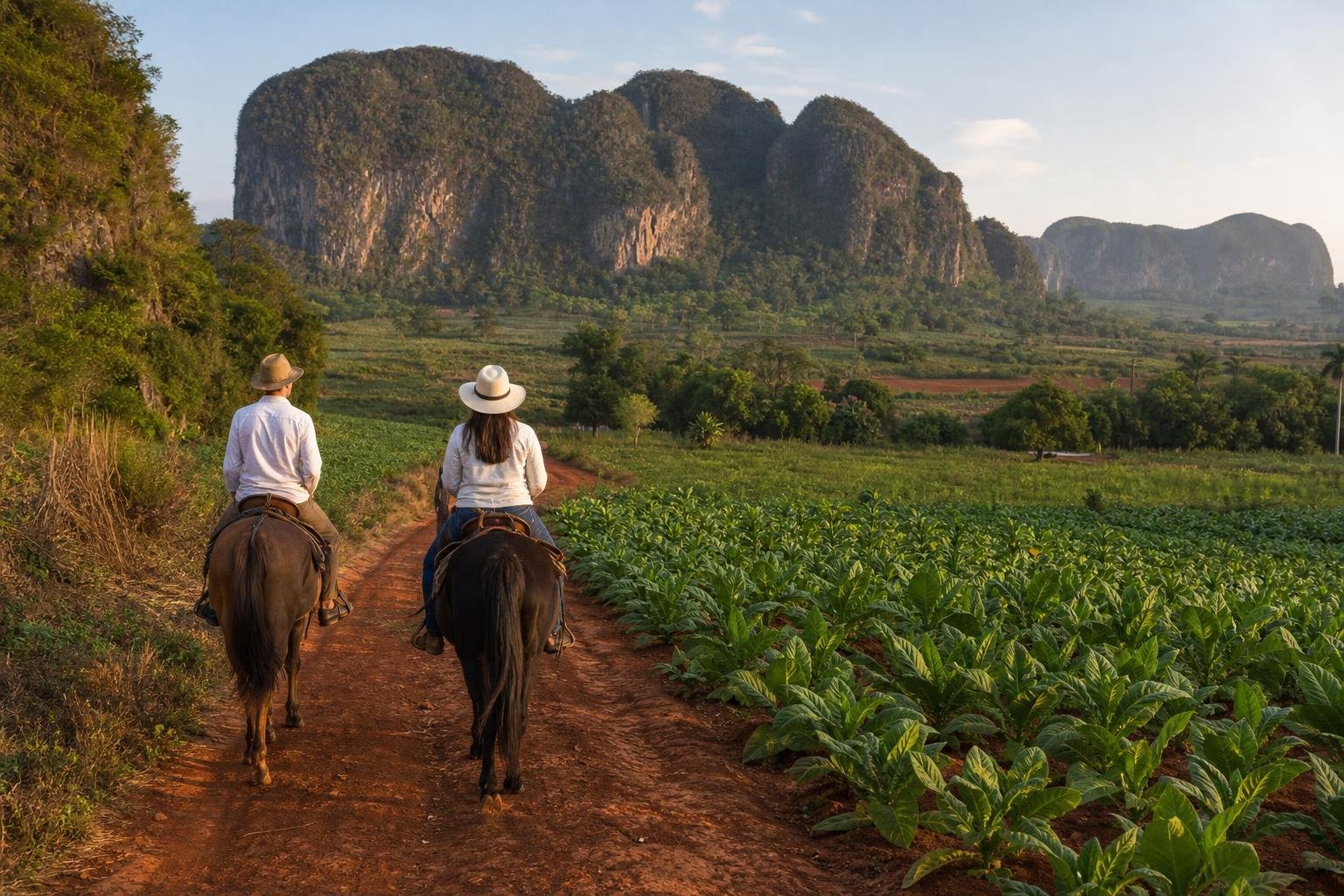
You can ride beneath Viñales’ limestone hills, walk between tobacco farms, and watch a farmer roll a cigar from dried leaves. The valley’s steep-sided mogotes rise above red earth and cultivated fields; a viewpoint lets you see their shape, while a trail brings you down into the working countryside. Add the painted cliff of the Mural de la Prehistoria, a beach day at Cayo Jutías, or dinner and dancing in town.
These eight things to do in Vinales Cuba take you from the fields to the coast, with time to stop along the way. Choose the experience that draws you outside, and let the valley occupy more than a passing glance.
In This Article
- From Havana to the Cuban Countryside: Reaching Viñales
- Things to Do in Vinales Cuba: Valley Days and Town Nights
- Frequently Asked Questions
- Key Takeaways
- Choose Your Valley Days First
From Havana to the Cuban Countryside: Reaching Viñales
The journey from Havana gives you your first look at the Cuban countryside. Buildings give way to agricultural land, and the view opens across fields. Near Viñales, limestone hills become the feature to watch for: their abrupt sides look quite different from the flatter ground around them. Take a window seat if you can.
A Viazul bus, a shared taxi called a colectivo, or a private transfer will get you there. The bus favors price over flexibility; a colectivo brings you closer to the convenience of a car without paying for the whole vehicle. A private transfer makes more sense when your group can share the cost or you want to stop along the way.
For planning, direct-drive estimates range from 90 minutes to two hours, while colectivo journeys take around 2.5 hours. Shared pickups explain some of that difference. Viazul takes around four hours, with fares quoted at $12–$17 per person. Transport schedules, prices, attraction hours, and music programs change, so these figures are a guide rather than fixed offers.
A colectivo seat has been quoted at $15–$20, compared with about $70 one way for a private car. Compare the cost for your whole group. The useful question is where the ride ends: arrival at your casa particular, a privately run guesthouse, saves carrying your bags from a central drop-off. Keep its full address offline, since connectivity can be limited.
Leave your arrival afternoon loose enough for a walk through town. After the drive, sitting down for a meal can be a better introduction than rushing straight onto a horse. If you continue to Playa Larga afterward, allow half a day for that transfer; it belongs in your travel schedule, not between two valley stops.
Things to Do in Vinales Cuba: Valley Days and Town Nights
The mogotes give Viñales its outline, but tobacco farming gives you a reason to look closer. Paths run through cultivated land, past farm buildings and rural homes. From above, those fields make a pattern. On the ground, you notice the leaves, the soil under your shoes, and the distances between one farm and the next.
For a first visit to Vinales Cuba, make one substantial outing the center of your day. A horse ride can include a tobacco-farm visit; a walk lets you linger over the same countryside at your own pace. Give each stop a purpose: get close to the farm work, gain a wider view, or take a proper rest.
That distinction matters more than collecting attractions. Valley of Silence and El Yayal belong to the walking side of a visit, while a mirador pulls your attention outward. The mural asks you to look at one painted rock face. Each changes what you notice, even when the limestone hills remain in sight.
Town has its own rhythm once you return. Dinner and music at Centro Cultural Polo Montañez can follow a day outdoors. Cayo Jutías takes you away from the fields altogether, so save the coast for a day when leaving the valley is exactly what you want.
1. Ride Through the Valley on Horseback
A horse ride brings the hills into view gradually. Farm paths carry you past fields and rural homes, with the mogotes rising above the route. The pleasure is in moving through that scale: a stretch of open ground, then a limestone wall that makes horse and rider look small.
Choose a guided ride that gives the countryside time to register. If the route includes a tobacco farm, the stop provides a natural break from the saddle and a chance to talk about the land you have been crossing. Tell the guide how much riding you have done and request a helmet. Those two details matter more than choosing the excursion with the longest list of stops.
You need not be an experienced rider to be interested in this outing, but you should want to spend time on a horse. If your attention keeps returning to a path you would like to explore slowly, walking may suit you better. The valley rewards either pace.
2. Visit a Tobacco Farm and See Cigars Made
At a tobacco farm, the crop becomes more than part of the view. Broad leaves in the fields are the beginning of a process that continues in drying barns, where harvested leaves hang to cure. The change in texture is part of the interest: growing tobacco and a finished cigar look very different.
A rolling demonstration brings that work into your hands’ range of vision. Watch how the roller gathers the filler leaves and wraps them into a cigar. It is a small-scale task compared with the fields outside, and that shift makes the visit worth slowing down for.
Let the demonstration lead into conversation. Ask which work occupies the farmer at that time of year, or how drying affects the leaves. Some visits offer cigars for sale, but you can appreciate the skill without smoking or buying anything. The most useful souvenir may be understanding what you were looking at along the trail.
3. Walk the Trails Around Viñales
Walking around Viñales Cuba gives you the freedom to stop where the ground catches your attention. Red dirt, field edges, and exposed limestone offer different details from the broad panorama. A muddy stretch after rain can also change your pace quickly; shoes with grip earn their place here.
One described approach follows a forest road for approximately 1.9 miles toward the Valley of Silence, with mogote views and El Yayal along the wider outing. A longer hike of about 9.3 miles is a different commitment. Choose the complete route and turnaround point before setting off, so the walk matches the amount of daylight and energy you want to spend.
Start early when possible, carrying drinking water and sun protection. Then give yourself permission to pause. Walking is particularly satisfying when you stop measuring progress only by distance: a field viewed from its edge can tell you more than another mile covered in a hurry.
4. Take in the Valley From a Mirador
A mirador puts space between you and the details. From an elevated viewpoint, you can follow the cultivated ground between the mogotes and see how sharply the limestone rises from it. The lookout at Hotel Los Jazmines is one place to get that wide view.
Go before a valley outing if you enjoy understanding the terrain first. Go afterward if you would prefer to recognize a stretch of countryside you have already crossed. The second approach gives the panorama a personal reference: you are looking across land where you have spent time, not simply admiring a distant shape.
Stay long enough to look beyond the nearest hill. The gaps between the mogotes matter as much as their faces, revealing more fields and further ridges. Take your photograph, then put the camera down for a while. This stop earns its place through attention, not duration.
5. See the Mural de La Prehistoria
Approximately 2.5 miles from town, the Mural de la Prehistoria turns a rock face into a painted account of the development of life. Work began in 1961 under artist Leovigildo González Morillo. The name refers to the subject of the painting, not to the age of the artwork.
That modern intervention is what makes the stop different from a trail or viewpoint. Large figures and strong colors occupy a surface you might otherwise study for its limestone. Look first at the whole composition, then at the relationship between the painting and the cliff supporting it.
Some visitors are drawn to that contrast; others find the unpainted hills more compelling. Give the mural time if public art interests you. If your main pleasure is walking through farms, it can remain a smaller part of the day. Its value is in offering a different way to look at the valley.
6. Pause for a Piña Colada
A piña colada is a reason to sit down after time on the trail. Pineapple and coconut give the drink its familiar flavor, with rum in the alcoholic version. If you want yours without alcohol, ask for that when ordering.
Choose the seat as carefully as the drink. Somewhere overlooking the valley lets the hills remain part of the afternoon without requiring you to keep moving through them. After a walk or ride, the change feels immediate: your legs rest, and the view carries on.
There is little value in chasing a claim about Cuba’s best cocktail. A satisfying stop depends on whether you enjoy being there. Leave enough room in the day to finish your drink without counting the minutes to the next departure; otherwise, a pause becomes another appointment.
7. Spend a Beach Day at Cayo Jutías
Cayo Jutías offers a clear change from Viñales: white sand and sea in place of tobacco fields and limestone. Mangroves form part of the coastal setting, and a causeway connects the cay to the mainland. The journey takes you out of the valley’s agricultural scenery toward a different kind of open space.
Make the beach your main destination that day. That leaves time to swim or sit on the sand without treating the coast as a brief stop between inland attractions. It also makes the journey worthwhile: the point is to settle into the beach, not simply reach it.
Arrange the outbound and return ride together, with a pickup place and return time. Once that is settled, transport can recede from your attention. If you have only a short stay in Viñales, weigh this day against another outing among the farms. Choose the coast because you want the sea, not because an itinerary feels incomplete without it.
8. Enjoy Dinner and Dancing in Town
After exploring the Cuban countryside, dinner in Viñales gives the evening a slower beginning. Sit down before deciding how late you want to stay out. An unhurried meal is enough of a plan after several hours on foot or horseback.
For music and dancing, Centro Cultural Polo Montañez offers a town venue to consider. Let the evening’s program determine whether you spend your time listening or join the dancing. You do not have to turn a night out into a performance of your own.
That change from looking to participating is part of the appeal. During the day, your attention goes to paths and fields; at night, it shifts to the people around you and the music in the room. Leave space for the evening to develop instead of deciding in advance that every hour needs an activity.
Frequently Asked Questions
What are some cool things to do in Cuba?
In Viñales, a guided horse ride, a tobacco-farm visit, and a walk among the mogotes are rewarding ways to spend your time. Add the mural if you enjoy public art, or a town evening if you want music and dancing. For a change of setting, devote a day to Cayo Jutías.
How far does $20 go in Cuba?
At the prices used here, $20 covers a $10–$15 meal and a drink around $2.50, with money left over. It will not also cover a full day of transport and paid activities. The payment currency and exchange conditions affect your spending power.
Should you bring toilet paper to Cuba?
Yes, bring a small roll or pocket tissues because public bathrooms may lack supplies. Keep them in your day bag, along with hand sanitizer. Use the bin for paper where the bathroom’s instructions require it.
What’s the best month to go to Cuba?
February is a strong choice for a Viñales trip because it falls in Cuba’s generally drier winter season. Walking and riding are usually more comfortable than during the hotter, wetter summer months. Leave a little flexibility for weather on outdoor days.
Is Viñales, Cuba worth visiting?
Yes, Viñales is worth visiting if you want outdoor time in working countryside beyond Havana. The limestone hills and tobacco farming give the valley its particular character. An overnight stay lets you enjoy a substantial outing without losing the town evening.
Is $1 USD a good tip in Cuba?
A $1 USD tip is a reasonable small gesture for a brief service. For a longer guided outing or substantial assistance, choose an amount that reflects the time and effort involved. Give cash in good condition and in a currency the recipient can use.
Key Takeaways
- Choose your main valley outing for the pace you enjoy: riding or walking.
- Let a farm visit explain the crop you see along the paths.
- Match the walking route to your available time; the short approach and longer hike are different outings.
- Use a viewpoint to connect the places you have explored, and give the mural time if its art interests you.
- Reserve a full day for Cayo Jutías, and leave town evenings open for dinner and music.
Choose Your Valley Days First
On your last valley outing, stop before the path carries you back toward town. Look from the worked ground to the limestone above it. By then, a field need not be anonymous: you may have seen its crop drying or watched its leaves become a cigar. Give that connection a moment. Then head back for dinner.