


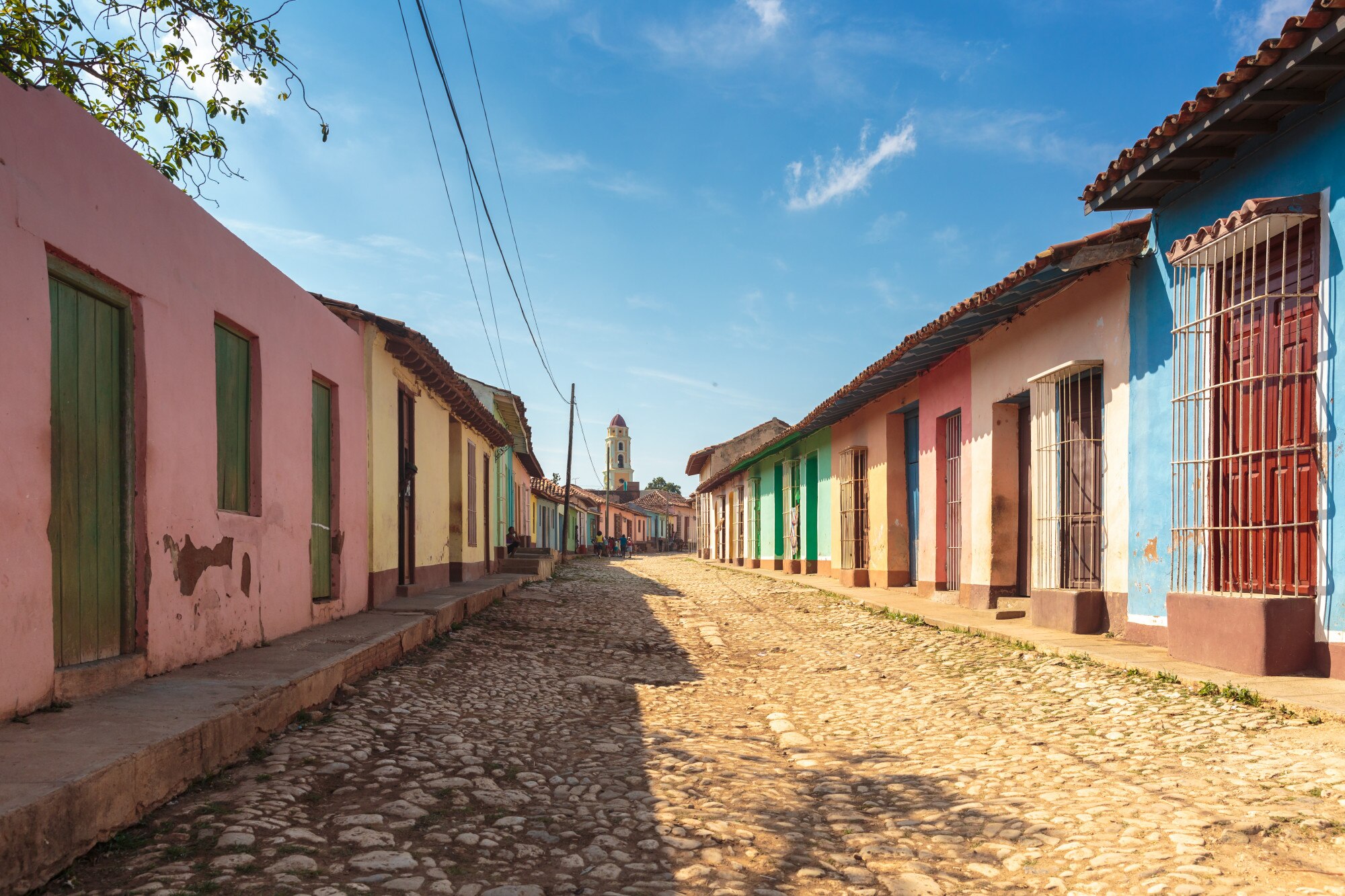
Around Plaza Mayor, cobbled streets lined with pastel facades and tiled roofs define the historic town of Trinidad, Cuba. Come for the architecture and evening music. Stay two or three nights to fit in a beach or countryside outing without cutting your time in town short.
That mix is easy to enjoy in Trinidad de Cuba, in Sancti Spíritus province on Cuba’s southern coast. Spend a morning among old houses, then listen to music beside the square that evening. Use the town as your base and choose an excursion to explore another side of its story.
In This Article
- Start With the Historic Center
- Make Time for Museums and Music
- Understand the Sugar Valley
- Spend a Beach Day at Playa Ancón
- Walk in Parque el Cubano
- Plan Your Journey to Trinidad
- Choose a Casa Particular That Fits Your Stay
- Plan a Full Day in Town
- Key Takeaways
- Frequently Asked Questions
Start With the Historic Center
Make Plaza Mayor your first stop, with its small garden square framed by pastel-colored buildings. Across the gardens, Palacio Brunet stands out for its broad facade and columned entrance. Smaller houses line the adjoining streets, lending a less formal feel beyond the square.
Follow those streets past tiled roofs and open doorways, giving them the same attention as the square. A shaded courtyard glimpsed through a doorway can change your impression of an otherwise modest house. These blocks are also residential, with everyday business carrying on among the buildings that draw visitors.
Much of this architecture was paid for by sugar wealth, built on enslaved people’s labor. That history links the grand houses to the everyday streets around them. In 1988, UNESCO inscribed Trinidad and nearby Valle de los Ingenios together, recognizing the town’s connection to its plantation countryside. On a guided walk, you can trace that connection through individual buildings.
Turn your attention from the facades to the ground beneath your feet. Uneven cobbles, with different-sized stones packed together, give these long streets their distinctive texture.
Make Time for Museums and Music
Start in the main hall of Palacio Cantero, home to the Museo Histórico Municipal, and take in the painted wall decoration. Architectural forms depicted on the walls turn the room itself into part of the display. From there, the courtyard opens to the sky. When accessible, the tower lets you look out across the tightly packed roofs.
For a closer look at affluent nineteenth-century life, visit Palacio Brunet, where the Museo Romántico displays furnishings and decorative objects. Let your interests decide which house to explore. Pick Cantero for the building and its view. Choose Brunet to linger over the way wealthy households furnished their rooms. Either museum can sharpen your eye for the streets outside.
Trade museum rooms for evening music at Casa de la Música, beside the steps near Plaza Mayor. Listeners sit on the steps as dancers gather below. Watch from the edge or join them. Once the museums close, the music shifts the square’s focus from its interiors to the activity outside. Set aside a separate budget for drinks and any admission charge.
Understand the Sugar Valley
The sugar estates of Valle de los Ingenios were workplaces sustained by forced labor, not retreats in the countryside. They reveal the source of the town’s prosperity. Out here, the remains connect directly to the history of the grand houses you have just visited.
Start at Manaca Iznaga, where a tall tower makes the estate easy to recognize. Together with the surviving buildings, it reveals the size of the plantation compound. A guide can separate documented uses from stories told about the site. That distinction keeps the workers in view, not just the owners’ buildings.
To see more of how sugar was produced, visit San Isidro de los Destiladeros. Ruined masonry walls trace the former sugar works, while a surviving bell tower stands above the remains. Spaces once enclosed within an industrial complex now lie open to the sky. These ruins give the valley’s history a physical form: sugar production needed workplaces as well as fields. The wealth on display in Trinidad began with labor here.
Spend a Beach Day at Playa Ancón
Playa Ancón is a white-sand beach about 7.5 miles from Trinidad. The drive buys you a real change of setting: a long sweep of sand facing the Caribbean, with room to walk along the shore instead of settling immediately beside the first access point.
The beach lies on the Ancón peninsula, outside the historic town. That separation is part of its appeal. A few hours here can be enough after a morning among enclosed courtyards and narrow streets; a full day lets the coast become the main event.
A taxi gives you control over departure time, while a shared ride works when other travelers want a similar stay. Agree on a return pickup and a clear meeting point. Sea conditions should determine whether you swim, but the beach is worth choosing for the sand and open view alone. If most of your holiday will be coastal, stay near the beach; for architecture and evening walks, keep your base in town.
Walk in Parque el Cubano
Around a 10-minute drive from the city center, Parque el Cubano is the starting point for a walk to Javira Waterfall. The drive gets you there; the trail is the reason to go.
Following a stream through woodland, the trail takes you into surroundings quite different from the streets around Plaza Mayor. At Javira, the water falls into a pool bordered by high rock walls. Those walls define the falls: the basin feels tucked into the rock, unlike the exposed setting of an open riverbank.
Leave plenty of time for the walk itself, rather than treating it as a route to the pool. Wear shoes suited to wet or uneven ground, and remember that rain can affect both the trail and the pool. Before entering the water, follow posted instructions and staff guidance. Swimming is an optional extra, not what makes the outing worthwhile.
Plan Your Journey to Trinidad
The road trip from Havana takes roughly five to six hours, mostly along the Autopista Nacional through agricultural country. As you approach Trinidad, the route turns onto smaller roads. Traveling through Cienfuegos puts the Caribbean to your south and the Escambray mountains inland for the final stretch. About an hour west of Trinidad, Cienfuegos also works well as a stop when you're visiting several cities.
For a lower-cost option, Viazul links Havana and Trinidad, with a reported journey time of about eight hours. Take the bus if price matters more to you than choosing where to stop. A private transfer lets you make those decisions, while a colectivo means sharing the vehicle with other passengers. Before booking the latter, confirm whether the fare covers one person or the whole car. Agree on the pickup and drop-off points, too.
Whichever transport you choose, schedules, fares, attraction access, and local service conditions can change. Leave your arrival evening flexible rather than booking a prepaid excursion that depends on getting there at an exact time. Aim instead to settle into your accommodation and take a first walk.
Choose a Casa Particular That Fits Your Stay
A casa particular is privately run accommodation, with the possibility of speaking directly to your hosts about life in town. The difference from a hotel is often that personal contact: the person welcoming you may also be the person helping arrange tomorrow’s driver.
Choose the house around the stay you want. A courtyard gives you somewhere to pause between outings; a location within walking distance of Plaza Mayor makes it easy to return to your room before going out for music. Look at the actual route, since “central” can still mean several uneven blocks with luggage.
Proximity to music has a trade-off: a room near evening entertainment can be noisier than one farther away. Decide whether you want to step straight into the evening or retreat from it. Tell your host your arrival time and transport method so that your first encounter is a welcome, not a missed handoff.
Plan a Full Day in Town
For one full town day, start in Plaza Mayor, then visit Palacio Cantero while you are still looking closely at the surrounding houses. After lunch, walk beyond the square into the residential blocks and return to your casa for a pause. Leave dinner unhurried, then head to the steps beside Casa de la Música.
Stay for a while. At night, the steps hold seated listeners, dancers move below them, and the old facades stand behind the music.
Key Takeaways
- Use the historic center as the starting point for understanding the town’s sugar-era wealth.
- Choose a museum for its particular interest, leaving space for an evening of music.
- Give each excursion a purpose: plantation history, time on the coast, or a woodland walk.
- Match your transport to how much control you want over the journey.
- Choose accommodation for the kind of evenings you want to have.
Frequently Asked Questions
Is Trinidad, Cuba Worth Visiting?
Yes, Trinidad is worth visiting if you enjoy historic architecture and a town you can explore on foot. Stay overnight so your visit includes an evening, instead of making it only a daytime stop.
Does Trinidad, Cuba Have a Beach?
Yes, Playa Ancón is Trinidad’s nearby beach, outside the historic center. Choose a town base if the beach is one outing; choose the coast if beach time is the reason for your stay.
How Do I Get to Trinidad, Cuba?
You can reach Trinidad from Havana by Viazul bus, private transfer, or colectivo. Take the bus for a budget-focused journey or a private car if you want to decide where to stop.
Is There a Place Called Trinidad in Cuba?
Yes, Trinidad is a Cuban city in Sancti Spíritus province. Include the province in your accommodation and transport arrangements to make the destination unambiguous.
What Can I Do Beyond Trinidad’s Historic Center?
You can explore the sugar valley, spend time at Playa Ancón, or walk to Javira Waterfall. Pick the valley if the town’s history has caught your attention, and save another outing for a separate day.